
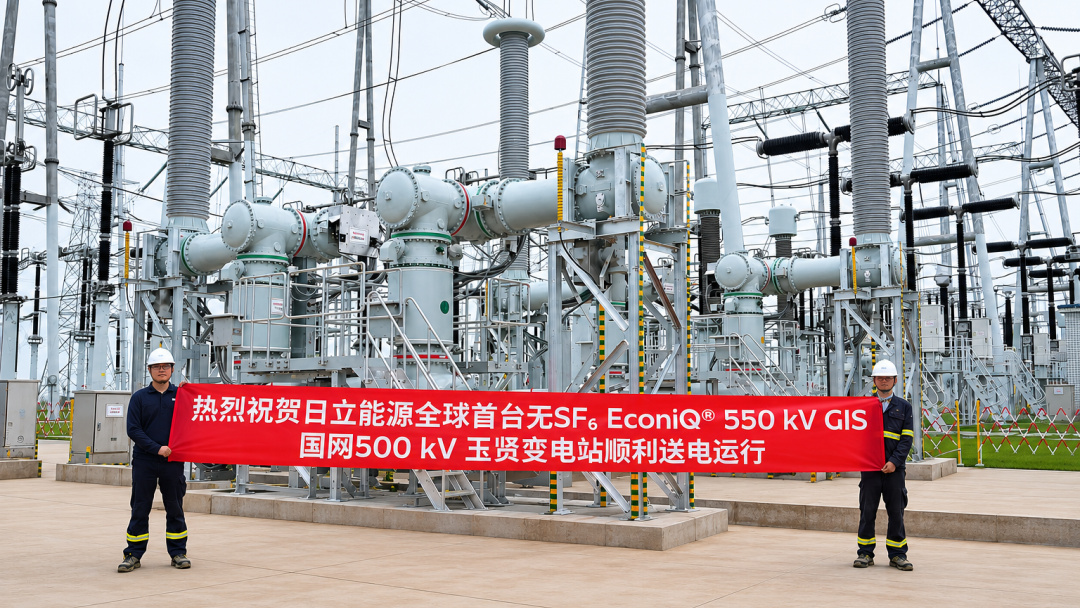
The world’s first 550 kV SF6-free (sulfur hexafluoride-free) Gas-Insulated Switchgear (GIS) has recently been commissioned in China, marking a milestone breakthrough in the low-carbon transition of power grids.
Two years ago, this product was only a prototype showcased on an exhibition stand in Paris. Today, it is delivering reliable power to Wuhan, a megacity in central China. This is not merely the innovation story of the world’s first SF6-free 550 kV GIS — it also reflects the profound implications for the future of environmentally responsible, high-efficiency energy infrastructure.
Located in Wuhan, Hubei Province, the 500 kV Yuxian Substation looks, from the outside, no different from any other large substation. Yet inside this substation operates a milestone innovation for the power industry — the world’s first SF6-free 550 kV GIS. On May 29, 2026, the equipment successfully completed grid connection, opening a new chapter in the green transition of extra-high-voltage (EHV) power transmission.
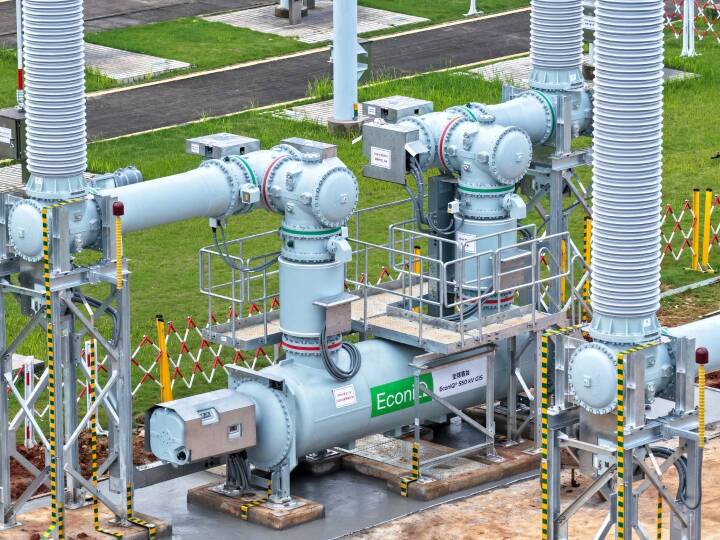
The world’s first SF6-free 550 kV GIS — commissioned at the Wuhan Yuxian Substation.
From Paris Debut to China Deployment
This achievement was first unveiled at the 2024 CIGRE Session held in Paris in the summer. On this important stage for the power industry, Hitachi Energy introduced the EconiQ® 550 kV GIS to engineers, grid operators, and policymakers from around the world. While drawing wide attention, the industry also remained cautious. Eliminating SF6 entirely from high-voltage switchgear is no easy task — and achieving this at the 550 kV EHV transmission level makes the challenge even more formidable.
Why SF6 Must Be Eliminated, and Why 550 kV Is Challenging
SF6 is often described as a “paradox” of the power industry: on one hand, due to its exceptionally superior dielectric (insulating) performance, it has become the widely used insulating gas in high-voltage equipment; on the other hand, its Global Warming Potential (GWP) is approximately 25,000 times that of CO2, and it can persist in the atmosphere for more than 1,000 years, imposing a long-term burden on the climate. In recent years, SF6-free solutions have been applied in equipment at lower voltage levels. However, for the 550 kV EHV class, equipment is subject to extremely stringent electrical performance requirements, and the industry has long held that SF6 would be difficult to replace for a considerable period of time.
Hitachi Energy’s solution is a carefully engineered eco-friendly gas mixture (86.5% CO2, 10% O2, and 3.5% C4-FN perfluoroisobutyronitrile), which satisfies the stringent requirements for dielectric performance and arc-quenching capability of 550 kV GIS while significantly reducing greenhouse gas impact. Calculated over a 40-year equipment service life, the carbon emissions of a single bay of conventional SF6 GIS are equivalent to approximately 1,674 tonnes of CO2 equivalent, whereas the EconiQ solution emits only about 12.6 tonnes — a reduction of 99.2% in greenhouse gas emissions. This breakthrough not only supports grid companies’ low-carbon development goals but is also highly aligned with China’s “Dual Carbon” strategic direction (carbon peak and carbon neutrality).
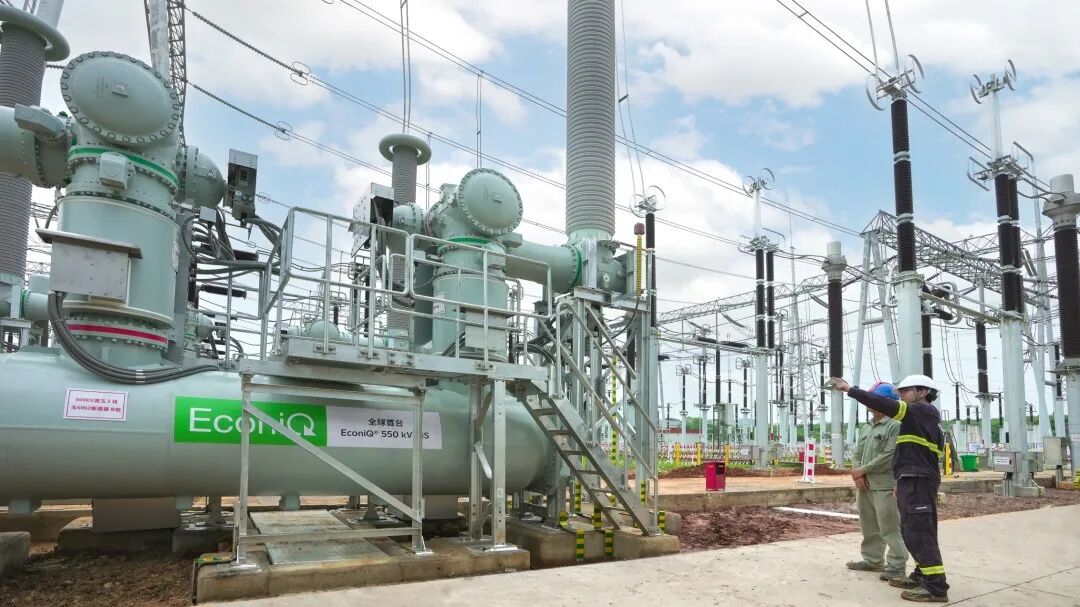
The EconiQ® 550 kV GIS in operation at the Wuhan Yuxian Substation — the world’s first SF6-free GIS deployed at the 550 kV voltage level.
What EconiQ GIS Application at EHV Means
The true meaning of “world’s first” is that the EconiQ GIS delivered here is the world’s first SF6-free GIS to achieve commercial deployment at the 550 kV voltage level and to undertake actual power transmission tasks within a real transmission grid. This means the technology has crossed a critical threshold in the energy and power industry: scaled deployment in real-world scenarios. It provides an important reference for grid operators, power utilities, and policymakers concerned with the green transition of EHV switchgear.
The Wuhan Yuxian Substation has thus become a landmark project for the industry, mirroring the multiple challenges faced by the global energy system: rapidly growing electricity load, ambitious low-carbon transition goals, and the pressing need to expand transmission infrastructure while avoiding long-term greenhouse gas emissions. The high-voltage equipment installed in substations today may still be in operation in 2065. Therefore, every technological choice made today is not merely about operations, but also about future climate impact — with effects that will extend beyond individual careers and across multiple policy cycles.
A Broader Outlook
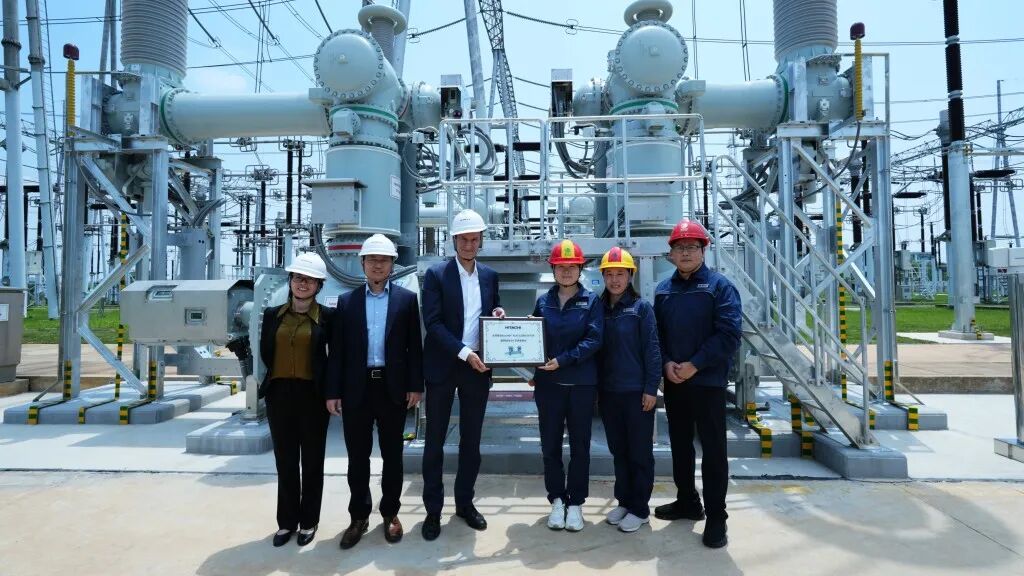
▲ In mid-June, Dr. Su Bin, Senior Vice President of Hitachi Energy China and Head of the High Voltage Products business unit for North Asia, together with Dr. Christian Ohler, Global Head of High Voltage Switchgear, and the delegation visited State Grid Central China Branch and toured the Wuhan Yuxian Substation.
Looking ahead, Hitachi Energy will continue to invest in R&D and innovation in environmentally responsible, high-efficiency high-voltage technologies, actively contributing to the decarbonization of China’s power grid, and working with customers and partners to accelerate the building of a more sustainable, more resilient, and lower-carbon energy future.
The successful commissioning of the Wuhan Yuxian Substation means far more than an engineering breakthrough. From now on, sustainable EHV transmission is no longer a technical concept but is truly integrated into actual grid operation, providing stable and reliable power supply to millions of users.
About Hitachi Energy: Hitachi Energy is a global technology leader in electrification, driving the evolution of the power era to meet the energy demands of today and the next 25 years. As the core energy business of the Hitachi Group, we leverage pioneering key technologies to power more than 3 billion people. Drawing on over a century of innovation heritage, we are actively addressing the most urgent energy challenges of our time: advancing the evolution of the global energy system to ensure that everyone has access to abundant, safe, affordable, and sustainable electricity. With world-leading installed capacity in more than 140 countries, we are a trusted grid ecosystem partner across the power, industrial, data center, and transportation sectors. Headquartered in Switzerland, the company has more than 56,000 employees across 60 countries and regions worldwide.